ATRIUMA ·
Where Your Home Budget Goes: Why Tracking Expenses Helps
Bills tell you what you paid. A clear expense history helps you decide what to change, from an unused subscription to a recurring household purchase.
The electricity bill is paid, the internet is covered and the household shopping seems ordinary. Yet the total at the end of the month is higher than expected. The explanation often becomes clearer when small purchases, services, repairs and recurring payments are gathered in one place.
Tracking expenses cannot lower an electricity tariff by itself or remove the need for a repair. It gives you a better basis for decisions: what you use, what keeps recurring and where a habit or contract might deserve another look. Whether you own or rent a home in Sofia or elsewhere in Bulgaria, the starting question is practical: what does this home actually cost?
Every amount in the examples below is hypothetical and expressed in EUR. These examples illustrate an approach to budgeting; they do not promise a particular saving.
Start with what you actually spend
It is tempting to create a budget around what you would like to spend. A more useful starting point is an honest record of current spending. The US Consumer Financial Protection Bureau recommends reviewing actual payments and less frequent expenses before planning changes. Read the CFPB's guidance on assessing spending.
Gather your receipts, invoices and existing notes. Record an amount, an expense date and a description that will still make sense next month. “Home stuff” says very little; “cleaning supplies” or “kitchen tap repair” gives you something to review. Keeping the supporting document also lets you check what an amount included.
Your first month does not have to be perfect. Choose a consistent moment to enter expenses, perhaps after a payment or during a weekly review. Build a record that is complete enough to answer useful questions, then improve it as the habit becomes familiar.
Pay attention to small recurring costs
Imagine finding a monthly service costing 12 EUR, an additional package costing 18 EUR and a subscription costing 9 EUR. Each amount may seem reasonable on its own. Together, they total 39 EUR. If one service is unused, you now have a specific task: check its terms and decide whether to keep, change or cancel it.
Purchases can reveal similar patterns. Two almost identical orders for household supplies in one week might suggest checking the cupboard before ordering. Three visits for the same minor fault might prompt a conversation about a lasting repair. The record reveals the repetition; you decide whether it is necessary.
There is no need to treat every convenience as wasteful. A service you use regularly and value may deserve its place in the budget. Choose one change for a clear reason, then review what happened the following month.
Compare periods that make sense together
A heating bill of 130 EUR in January does not automatically indicate a problem because September's recorded amount was 85 EUR. The season, weather, number of occupants and one-off purchases can explain a difference.
Look at the previous month and, where you have records, the same month last year. Check whether both periods are equally complete. If an invoice or purchase is missing from one, the difference is not yet a dependable basis for a decision. A higher total is a reason to review documents, contract terms and consumption.
Be equally careful about distinguishing a home's expense from how people share it. If one occupant pays a 60 EUR household bill and another reimburses them 30 EUR, the home still incurred a 60 EUR expense. The reimbursement does not create another expense for the same bill.
Using Bills and statistics in ATRIUMA
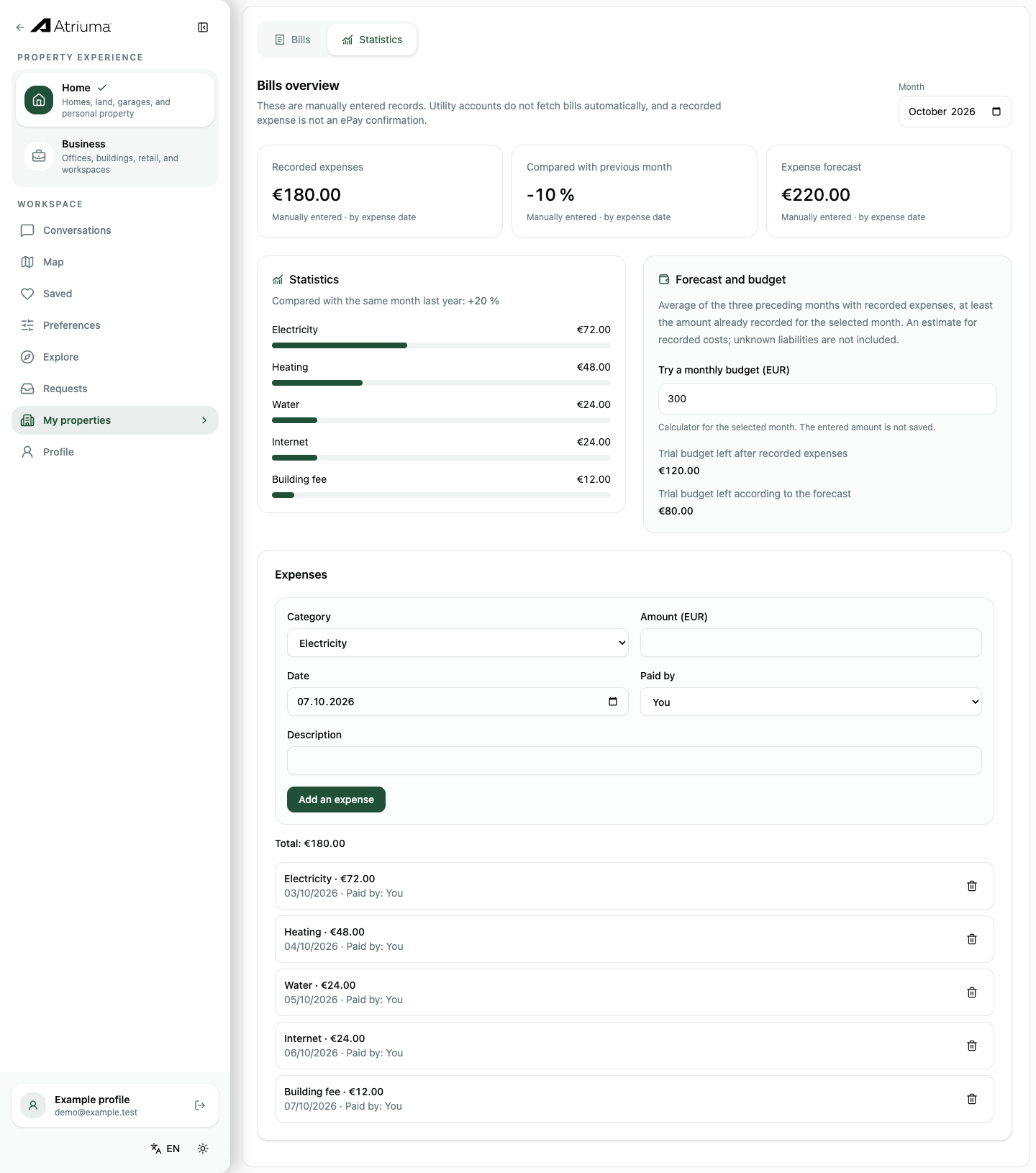
Each home in ATRIUMA has a Bills and statistics section with Bills and Statistics views. You enter expenses manually by their expense date. You can then review them by month and, where records exist, compare them with the previous month and the same month last year.
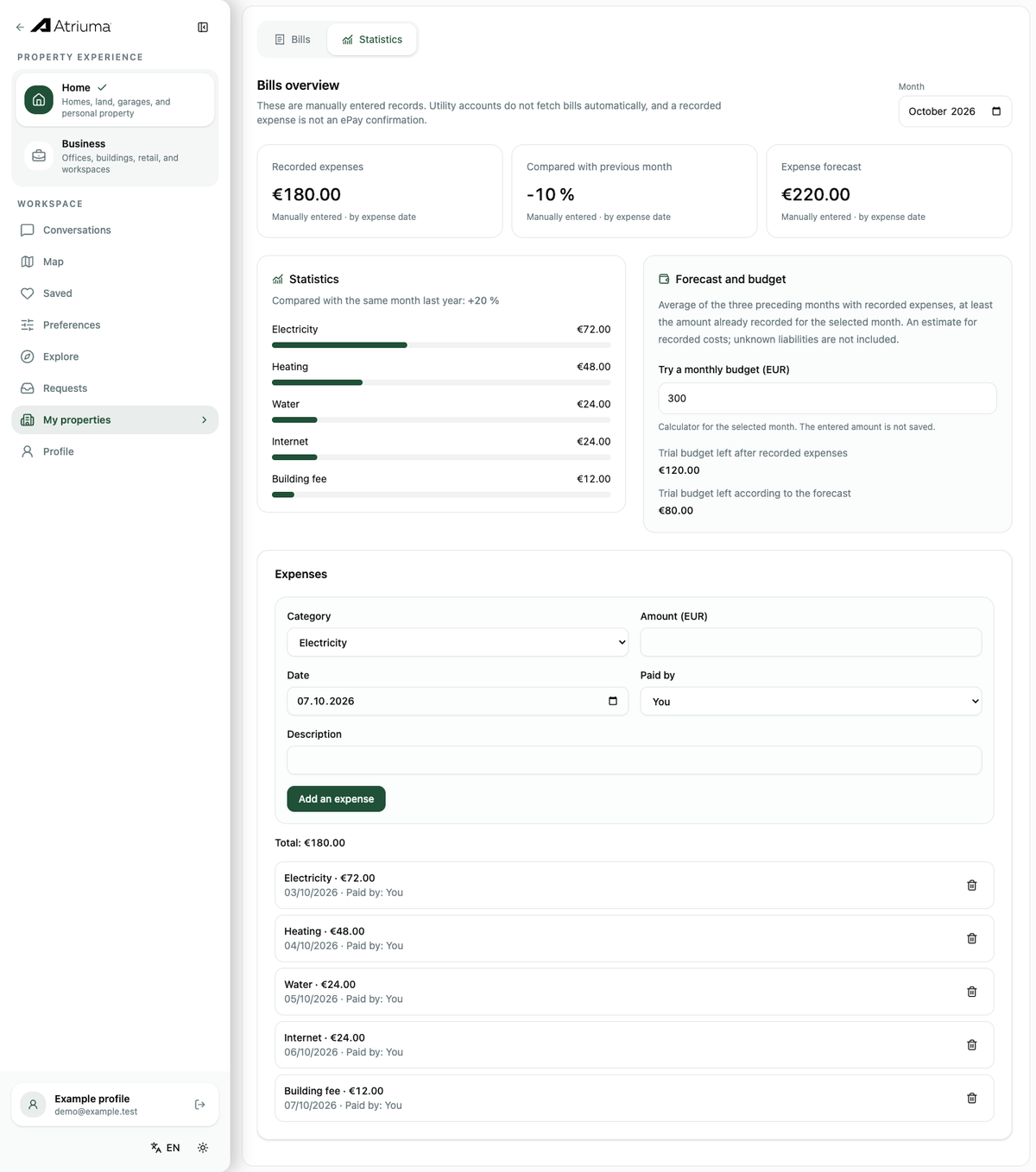
The record is useful when you keep it complete. Adding utility accounts does not automatically retrieve invoices from suppliers. Check your documents and enter the corresponding expenses. Manually marking an expense is also not a payment confirmation from ePay or another payment service. Check the service itself and the payment document when confirming payment status.
Payment requests between an owner, co-owner and tenant are a separate process. Review them separately from the home's expense total so that you do not count the same amount twice. For the wider organisation of a home, explore property management with ATRIUMA.
Understand what the forecast includes
ATRIUMA's forecast uses the average of the preceding three months only when each of those months has records. For example, 210 EUR, 240 EUR and 270 EUR produce an average of 240 EUR. If the expenses already entered for the selected month total 285 EUR, the forecast is at least 285 EUR.
A missing month is not treated as zero spending. Unknown liabilities are not included. Read the forecast alongside what you already know: an upcoming annual charge, an agreed repair or an invoice you have not entered yet. Those amounts can affect your own plan before they appear in your records.
The trial monthly budget calculator helps you consider a scenario, but the value you enter is not saved. Suppose you try a budget of 320 EUR, have recorded 280 EUR and expect another 80 EUR. Your planned total becomes 360 EUR. That is a useful moment to adjust your plan before making the next optional purchase.
Make the review a manageable habit
Once a week, add anything you missed. At the end of the month, review three things: which payments recur, which differences have a clear explanation and which single change you want to make. At the next review, assess the result using your own records.
If you already use ATRIUMA, sign in, open your home and start with Bills and statistics. Enter a few real expenses, then gradually complete the month. A clearer picture helps you direct money towards what your home actually needs and what your household values.